


Dealer Management System: Why Your Dealership Is Losing Profit Between Departments
If you ask a dealership owner where profits are under pressure, you’ll usually hear familiar answers.
Vehicle margins are shrinking.
Competition is tougher than ever.
Customers expect faster service.
Labor costs keep rising.
All of those are true. But here’s something many dealerships don’t realize.
The biggest profit leaks often have nothing to do with selling cars. They happen in the moments when one department hands work over to another.
Sales hands a vehicle to service.
Service waits for parts.
Parts waits for purchasing.
Finance waits for paperwork.
Management waits for reports.
Each delay might only cost a few minutes. On its own, it seems insignificant. Across hundreds of vehicles, repair orders, warranty claims and customer interactions every month, those small delays quietly become thousands of lost hours and thousands of euros in missed profit.
The problem isn’t that your people aren’t working hard. It’s that your departments aren’t working together as efficiently as they could.
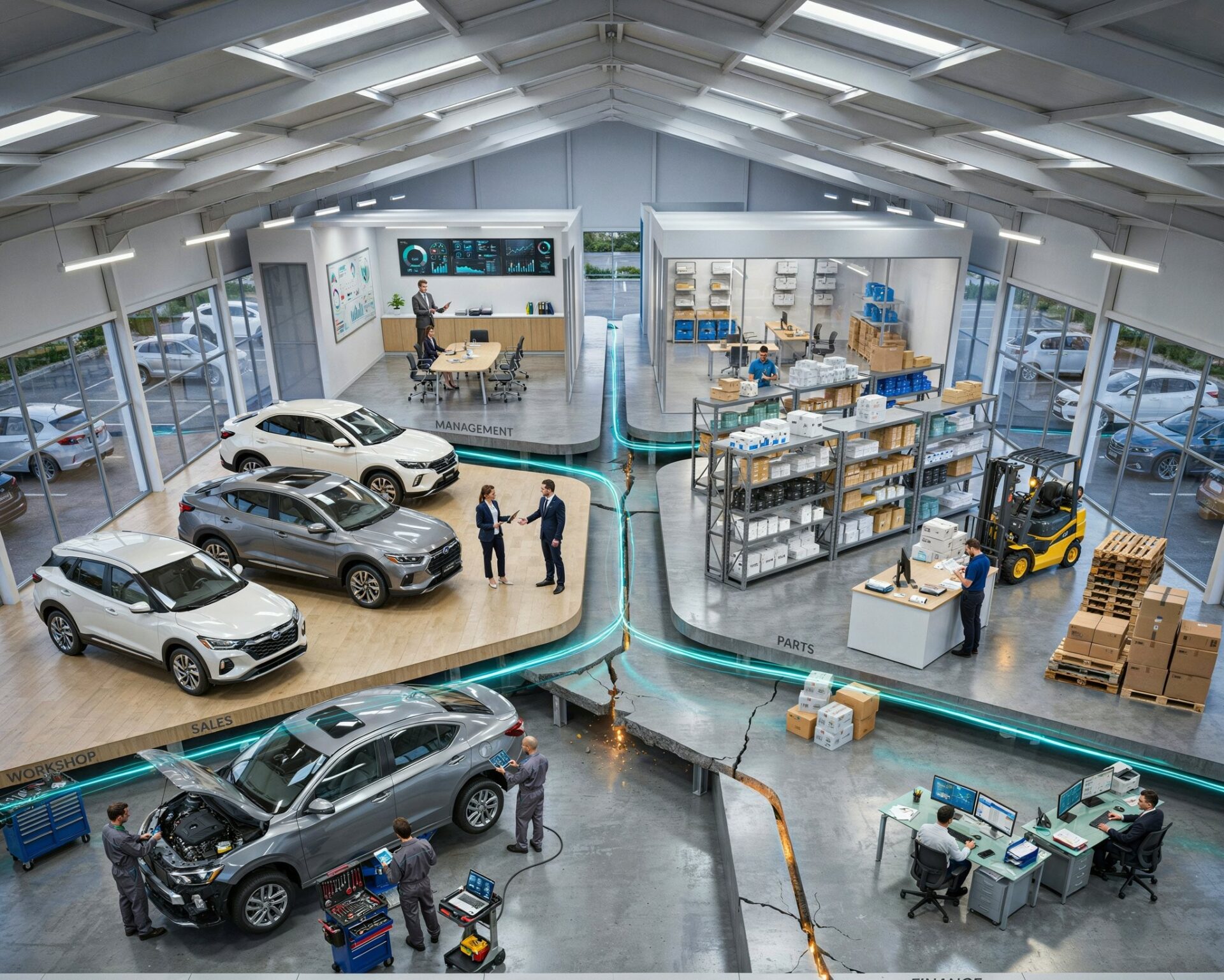
Every department performs well. The dealership doesn’t.
Most dealerships don’t struggle because of one poorly performing team.
Sales hits its targets.
The workshop stays busy.
The parts department keeps inventory moving.
Finance closes the books.
Individually, each department looks productive.
Yet customers still experience delays, employees spend time chasing information, and managers feel like they’re always reacting instead of planning.
Why?
Because departments are often optimized individually instead of as one connected operation.
Think about a typical service appointment.
A customer books a repair online.
The service advisor creates the job.
The workshop schedules a technician.
The technician discovers an additional issue.
The required part isn’t available.
The customer needs another appointment.
Finance updates the invoice.
The customer finally collects the vehicle.
Nothing in this process is unusual.
But every handover introduces another opportunity for delays, duplicate work or miscommunication.
The longer those handovers take, the lower the profitability of the entire dealership.
The hidden cost of disconnected operations
Most dealerships can easily measure vehicle sales.
They know how many cars they sold last month.
They know workshop revenue.
They know parts turnover.
What often goes unnoticed is everything that happens between those numbers.
For example:
- A service advisor spends ten minutes calling the parts department to confirm availability.
- A technician waits because a repair order is missing information.
- A warranty claim is delayed because customer history is stored in another system.
- Sales promises a delivery date before workshop preparation is complete.
- Finance waits for paperwork before invoicing can begin.
None of these situations appear on a profit and loss statement.
Yet together they consume valuable technician hours, delay customer payments and reduce workshop capacity.
These are operational costs hiding in plain sight.
Departments don’t need more meetings. They need better visibility.
Many dealerships respond to these problems by adding more communication.
More meetings.
More phone calls.
More emails.
More spreadsheets.
That treats the symptoms rather than the cause.
People aren’t searching for information because they enjoy it.
They’re searching because the information isn’t available where they need it.
A modern Dealer Management System should eliminate that search.
Everyone involved should be working from the same information at the same time.
When a service advisor opens a customer record, they shouldn’t need to ask whether parts have arrived.
When a salesperson checks vehicle availability, they shouldn’t need to call another department.
When management reviews workshop performance, they shouldn’t be looking at yesterday’s numbers.
Good decisions start with good visibility.
What connected dealership operations actually look like
Imagine a normal Tuesday morning.
The workshop begins the day already knowing which vehicles are arriving, which parts are in stock and which technicians have available capacity.
Sales can instantly see whether a vehicle is available, reserved or currently in preparation.
The parts department receives demand automatically instead of reacting after work has already been scheduled.
Finance has real-time visibility into completed work and outstanding invoices.
Management opens a dashboard instead of requesting reports from multiple departments.
Nobody has to become a superhero.
The dealership simply spends less time waiting.
That’s where efficiency comes from.
Technology isn’t the advantage anymore. Workflow is.
Most dealerships already have software.
Some even have several excellent systems.
The challenge isn’t necessarily replacing everything.
It’s making sure every department works from the same source of truth.
At ELVA DMS, we’ve seen dealerships transform performance not because they hired more staff or worked longer hours, but because they removed friction between departments.
Built on Microsoft Dynamics 365 Business Central, ELVA DMS brings together sales, service, workshop management, spare parts, purchasing, finance and reporting within one connected business platform.
Instead of moving information between systems, your teams move work forward.
That difference matters every single day.
Where ELVA DMS makes the biggest impact
A connected Dealer Management System helps dealerships reduce the operational friction that quietly eats into profitability.
With ELVA DMS, dealerships can:
- Manage vehicle sales, workshop operations and spare parts from one platform.
- Give service advisors real-time visibility into parts availability.
- Schedule technicians based on actual workshop capacity.
- Track inventory across multiple locations.
- Connect financial data directly with operational activity.
- Generate live management reports without exporting spreadsheets.
- Integrate naturally with Microsoft 365 tools your teams already use.
- Support multi-company and multi-branch dealership operations from one solution.
These aren’t just software features.
They’re improvements that save time, reduce errors and help every department make better decisions.
Questions every dealership should ask
Before investing in another system, it’s worth asking a few simple questions.
- How much time do employees spend searching for information every day?
- How many processes require someone to re-enter the same data?
- How often do departments rely on emails or phone calls to complete routine tasks?
- Can management see today’s performance without asking someone to prepare a report?
- Does every department work from the same customer and vehicle information?
If several of these questions are difficult to answer, the issue may not be your people.
It may be the way your business systems work together.
The dealerships that grow aren’t necessarily the ones selling the most vehicles
Successful dealerships aren’t just better at selling.
They’re better at operating.
They remove delays before customers notice them.
They help technicians spend more time repairing vehicles instead of waiting.
They give service advisors the information they need without switching between systems.
They provide managers with real-time visibility instead of yesterday’s reports.
Those improvements may seem small on their own.
Together, they create a dealership that’s faster, more profitable and easier to manage.
Because in today’s market, profit isn’t only created when a vehicle is sold.
It’s protected every time information moves smoothly from one department to the next.
If you’re wondering where your dealership could operate more efficiently, we’d be happy to show you.
Book a personalized ELVA DMS demo and discover how one connected platform can help your sales, workshop, parts and finance teams work as one business.